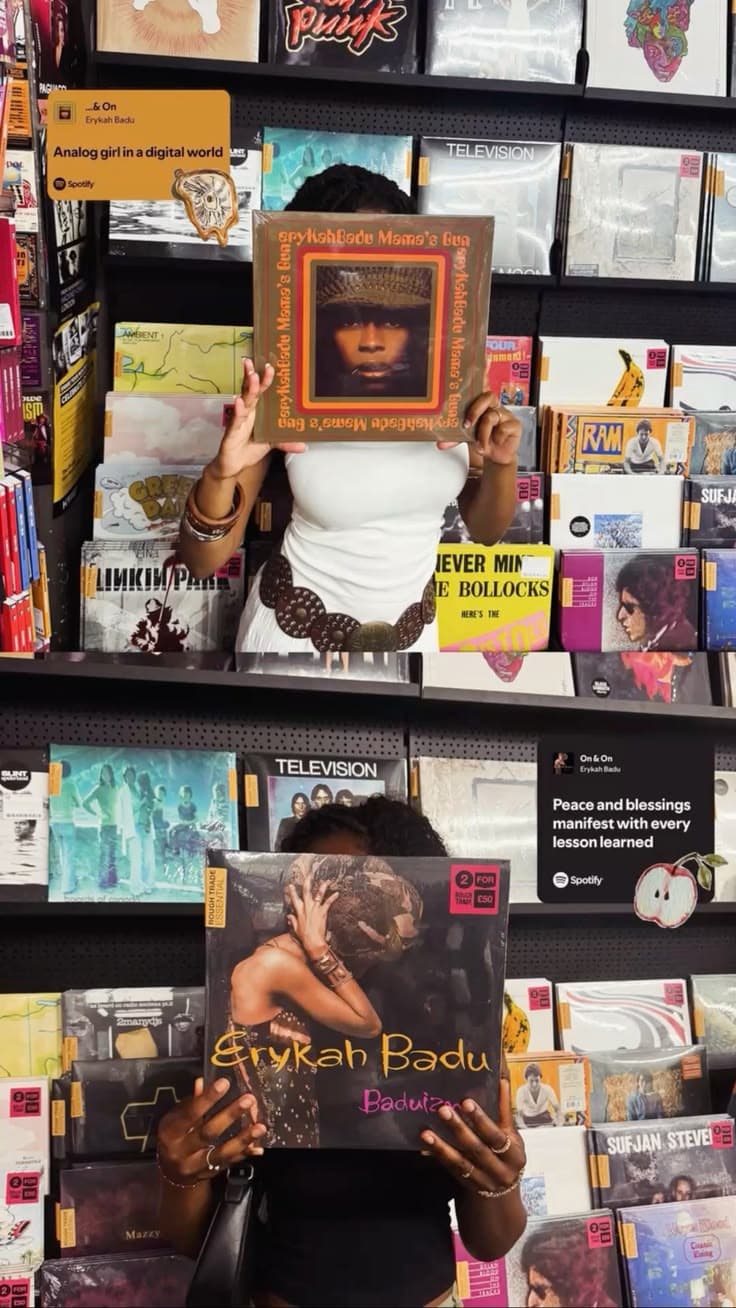
Why we still listen to albums
Words
Kwame Asante
Role
Editor
Published
Aug 14, 2026
Read
8 min
In an age of infinite skip, the album still asks something of you that a single never will: your time. It asks you to sit with an idea long enough for it to become familiar, uncomfortable, surprising, and eventually your own.
There is something different about pressing play on a full record. You know that feeling when the first track ends and, before you have decided whether you liked it, the next one has already started? That small moment of surrender is part of what makes an album different from almost everything else we consume.
A playlist can give you exactly what you want. An album can give you something you did not know you wanted. That distinction matters. The playlist is built around preference, while the album is often built around intention. Someone decided what comes first, what comes next, where the energy should rise, where it should fall, and when the room should become quiet.
For years, the album has been treated as if it were simply a collection of singles. But the strongest records have always been more deliberate than that. They create relationships between songs. A lyric in the second track might mean something completely different after you hear the seventh. A melody might return near the end in a new form. An intro that initially feels unnecessary might become the thing that makes the final song hit harder.
That kind of sequencing requires patience. It assumes that the listener is willing to stay. In a culture where almost every platform is designed to remove friction, the album introduces a little friction of its own. It tells you that not everything needs to happen immediately.
We spoke with producers, artists, collectors, and everyday listeners about what keeps bringing them back to full-length records. Their answers were different, but they kept circling the same idea: memory.
( in their words )
“A record asks for your attention in a way a playlist never does.”
People rarely remember every track on every album they have heard. What they remember is where they were when the record found them. The bus ride. The bedroom. The relationship. The long drive home. The particular year when everything felt uncertain. Albums become containers for those moments because they stay with us longer than individual songs often do.
There is also something physical about the experience. Even when the record exists only as a digital file, an album still has an object-like quality. It has a beginning and an end. It has artwork, a title, a sequence, and a world around it.
Maybe that is why albums continue to matter even when technology has made them less necessary. We no longer need a collection of songs packaged together to listen to music. We choose albums because we want the experience of entering someone else's world for a while.
The album survives not because it is the most efficient way to consume music, but because efficiency was never really the point.
AlbumsListeningSequencingCulture
Gallery photography by Christian Agbede, Clay Banks and Karl Hörnfeldt on Unsplash. Interviews conducted and condensed by the editorial team.